
Section 00
The Instruction That Makes Everything Worse
Rohan's class teacher had written the same thing on every report card for three years: 'Rohan needs to apply himself more.' His parents had said the same thing to him hundreds of times. By ten years old, Rohan had stopped processing it as information and started processing it as verdict. The day his mother asked me 'Why can't he just try harder?' — I knew we needed to start at the beginning.
'The part of the brain that organises, plans, and initiates effort,' I said, 'is the exact part that ADHD affects most directly. Telling Rohan to try harder is like telling someone with a broken leg to just walk normally.'
Section 01
What Is Executive Function?
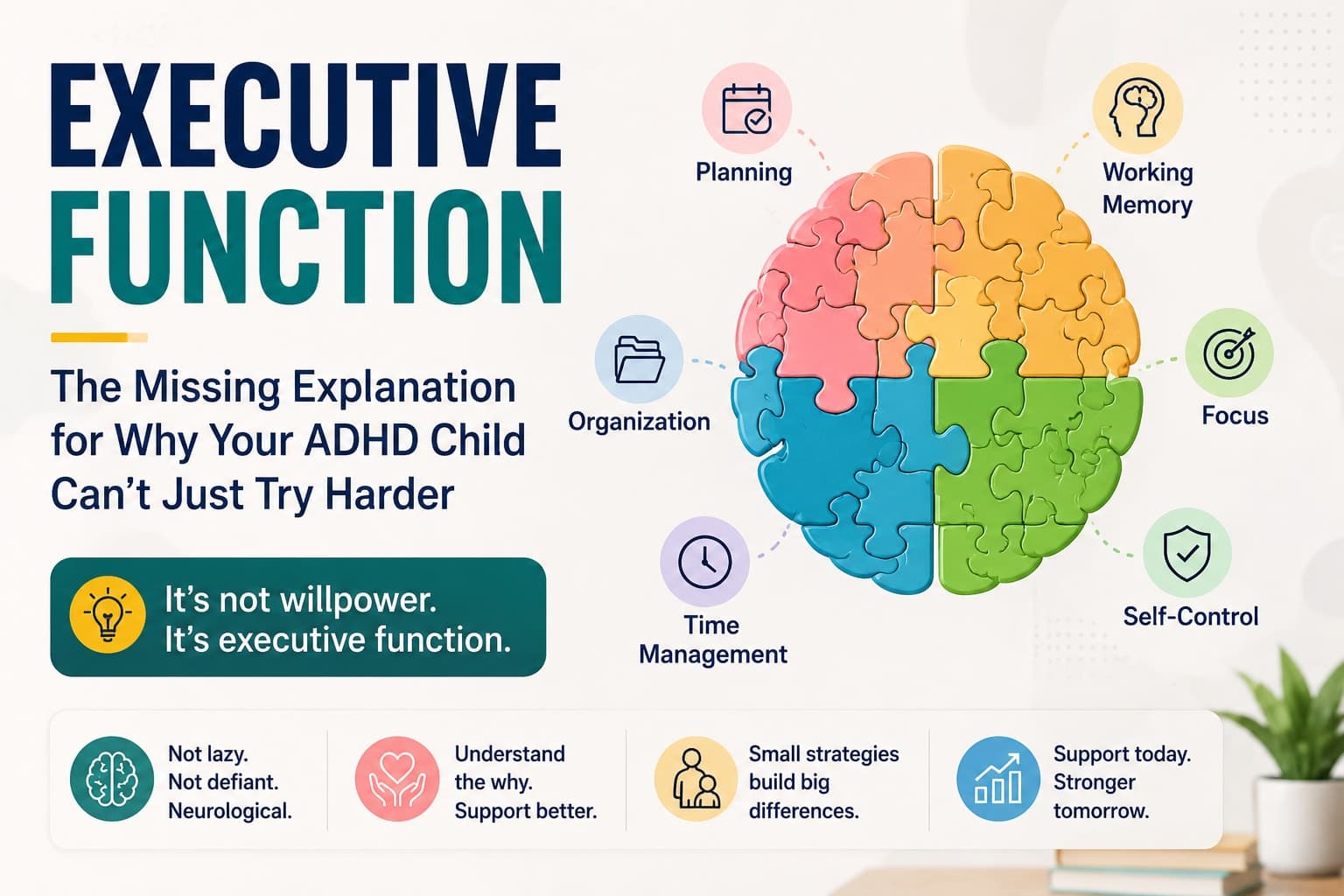
Executive function is the set of mental skills that allow a person to plan, organise, initiate, monitor, and regulate their own behaviour and thinking — the brain's management system. In ADHD, the prefrontal cortex — where executive functions are primarily housed — develops and functions differently. Dr. Russell Barkley, one of the world's leading ADHD researchers, has argued that ADHD is fundamentally a disorder of executive function rather than attention per se. The attention difficulties of ADHD, on this view, are a consequence of impaired executive regulation of attention.
Section 02
The Six Core Executive Functions — And What ADHD Does to Each
1. Inhibitory Control — The Brake Pedal
The ability to stop a thought, behaviour, or response that is not appropriate in the moment. In ADHD this explains: blurting out answers, following tangential thoughts mid-lesson, starting new activities before finishing the current one.
2. Working Memory — The Mental Scratchpad
Holding information in mind while using it. A low working memory score explains why a child forgets instructions moments after hearing them, loses track mid-task, and needs things repeated. One of the functions most consistently affected in ADHD.
3. Cognitive Flexibility — Mental Gear-Shifting
Shifting thinking between tasks, adapting to new information. In ADHD: difficulty with transitions, getting stuck on one approach, disproportionate distress when plans change unexpectedly.
4. Planning and Organisation — The Project Manager
Breaking a goal into steps, sequencing logically, estimating time. In ADHD: projects started the night before the deadline, bags consistently chaotic, no visible planning before written work, assignments consistently incomplete.
5. Task Initiation — Getting Started
Beginning a task — especially an effortful or uninteresting task — without excessive delay. In ADHD: 'in a minute' for 45 minutes (not defiance — a genuine neurological barrier to initiating); begins immediately when parent is present but cannot begin alone.
6. Emotional Regulation — Managing Feelings
Managing emotional responses in proportion to the situation. In ADHD: disproportionate reactions to minor frustrations, rapid escalation, difficulty recovering from upset, strong reactions to corrections.
Section 03
Why 'Try Harder' Cannot Solve an Executive Function Deficit
Trying harder requires executive function. Planning to try harder requires planning — executive function. Initiating the effort requires task initiation — executive function. Monitoring whether it is working requires self-monitoring — executive function. The instruction to try harder uses the exact cognitive system that is functioning less efficiently. It is the neurological equivalent of telling someone with a broken arm to carry more weight. Improvement comes from external supports that compensate for the executive function deficit, and from explicitly taught strategies that build executive function skills over time.
Section 04
What Actually Helps
External scaffolding:
Visual schedules — a picture or list of what happens in what order, removing the need to hold the sequence in working memory
Written instructions — removing the working memory demand of remembering verbal instructions
Timers and alarms — compensating for impaired time perception
Checklists — reducing the planning and monitoring demand on executive function
Physical organisation systems — specific places for specific things
Executive function coaching:
Explicit, structured coaching in executive function skills — teaching how to break tasks into steps, estimate time, use planners and checklists, initiate tasks using specific strategies, and regulate emotional responses to frustration. These skills can be learned — but they must be taught, not assumed.
Section 05
How to Explain Executive Function to Family and Teachers
For teachers:
'Rohan's ADHD means the part of his brain that manages planning, getting started, and staying on task works differently from most children's. He is not choosing to be disorganised. What helps most is: written instructions alongside verbal ones, a visual schedule, individual check-ins to help him start tasks, and patience with transitions.'
For grandparents:
'Think of executive function as the brain's manager. In most children, this manager develops through childhood and gradually takes over organising and directing everything else. In children with ADHD, this manager develops more slowly and works less reliably. Rohan needs more external help — until his own gradually develops. It is neurology, not will.'
*If you would like a clinical conversation about executive function coaching for your child, reach out through thechildpsychologist.in or call 7999215093.*
Section 06
If You Are in Indore or Nearby
If you are based in Indore, Bhopal, Ujjain, Dewas, or nearby areas, Dr. Vini Jhariya is available for in-person consultations. For families outside Indore — across India and internationally — online consultations are available through thechildpsychologist.in.
Address: 100-A Baikunth Dham Colony, Old Palasia, Saket, Indore, Madhya Pradesh
Phone: 7999215093
Website: thechildpsychologist.in
Section 07
The Manager Is Still Learning
Rohan's mother started using different language at home. Instead of 'try harder,' she began to say: 'Let's set up your tools.' Three months later, his class teacher wrote: 'Rohan is making a real effort to use his organisational tools and it is showing in his work.' He was trying harder. But this time, he had the tools to do it. Reach out through thechildpsychologist.in or call 7999215093.
A note for parents
This article is educational guidance and does not replace an individual psychological consultation or assessment.
Questions and answers