
Section 00
Three Tutors. Two Hours of Homework Every Night. Still Failing.
Vikram's parents had done everything right — or so they thought. When Vikram began falling behind in Class 4, they hired a tuition teacher. Three months later, his marks had not improved. They hired a second teacher. Another three months. No improvement. By the time they came to me, Vikram was in Class 6, working with his third tuition teacher, spending two to three hours every evening on homework that his peers completed in forty minutes. He was exhausted, increasingly avoidant of all academic work, and had recently told his mother he was stupid.
'We don't understand. He has had more academic support than any other child in his class. Why is nothing working?'
The answer was sitting in the question itself. Vikram had been given more academic support — more of the same kind of instruction. But the instruction was not addressing the neurological reason for the underperformance.
Section 01
Why Tuition Fails ADHD Children
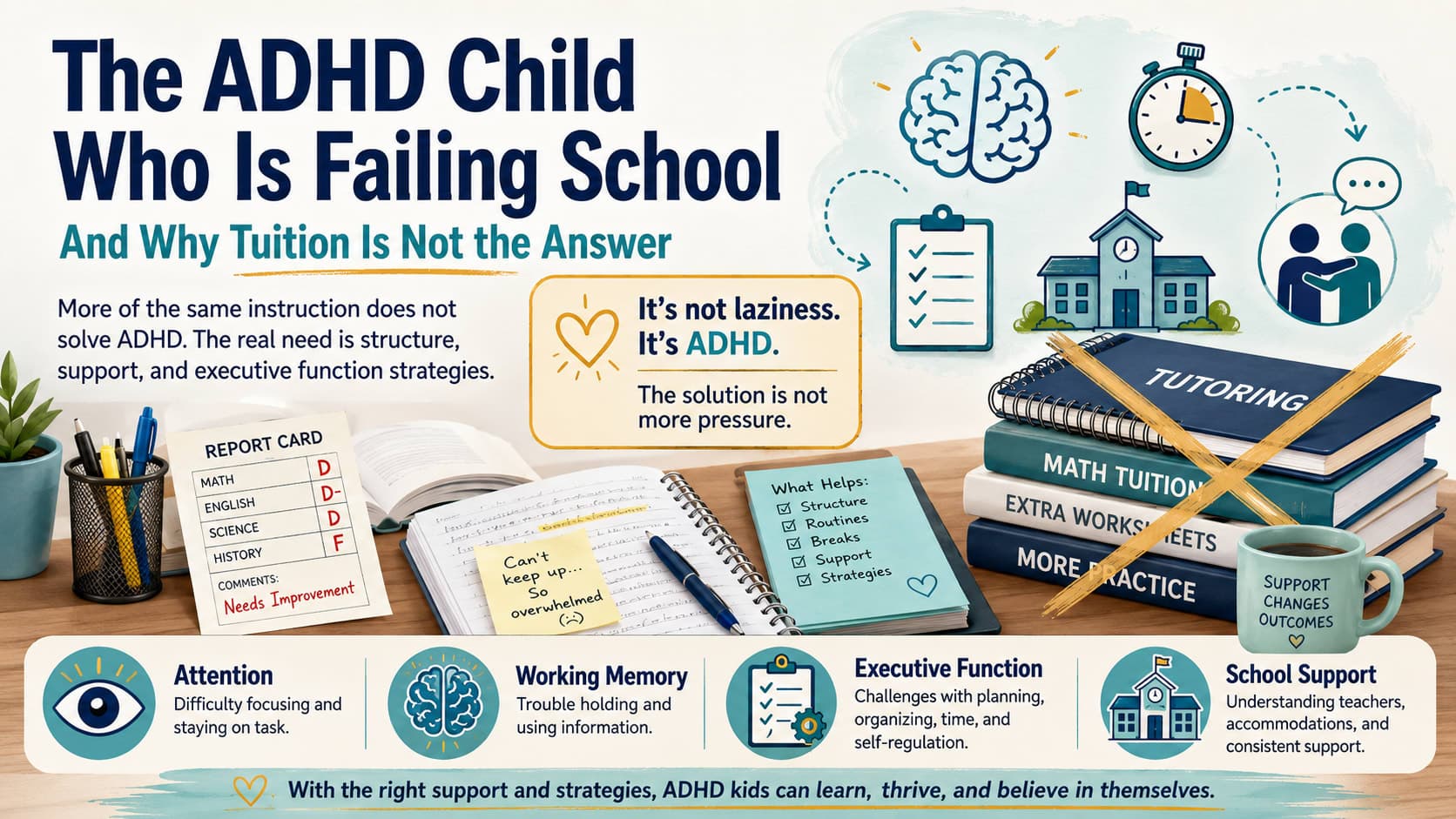
Tuition assumes the reason a child is underperforming is that they have not understood or practised the material enough. This is a perfectly reasonable assumption for a child whose difficulty is caused by gaps in knowledge. It is the wrong assumption for a child with ADHD. A child with ADHD is not underperforming because they lack knowledge — they are underperforming because of neurological differences in attention regulation, working memory, processing speed, and executive function. None of these are addressed by giving them more time with a tuition teacher doing more of the same thing.
Section 02
What the ADHD Brain Actually Needs to Learn
External structure:
The ADHD brain's executive function system functions less efficiently than in neurotypical peers. The child relies heavily on external structure. A highly structured environment with clear, predictable expectations and tasks broken into explicit steps is not an accommodation that makes things easier — it is a compensation for a neurological difference.
Reduced demand on working memory:
Working memory is one of the most consistently impaired functions in ADHD. Without strategies that reduce this demand — visual aids, written prompts, chunked tasks, external memory tools — the working memory deficit is a constant barrier to academic performance.
Engagement and interest:
ADHD brains can focus intensely on tasks they find genuinely interesting. The attention difficulty is specifically with tasks that are not intrinsically motivating. A child who cannot focus on a grammar worksheet for five minutes may focus on a history documentary for ninety minutes. The problem is not attention per se — it is the regulation of attention in low-stimulation contexts.
Frequent, immediate feedback:
ADHD brains respond to immediate feedback. Long-term consequences — 'if you study now, you'll do well in the exam in six weeks' — do not motivate ADHD children effectively. Short-term, immediate, positive feedback is neurologically more engaging.
Section 03
What Actually Works — A Framework
At school:
Extended time, preferential seating, written instructions — under RPWD Act 2016
A letter from the assessing psychologist to the class teacher explaining the specific support needed
At home:
Fixed, predictable homework time — after a snack and brief physical activity
Low-distraction environment
Tasks broken into 15–20 minute chunks with short breaks between
Parent physically present to provide external structure and immediate feedback
Start with the easiest or most interesting subject to build momentum
Use a visible timer rather than open-ended time
Know when to stop — a child who has been fighting their attention for two hours has nothing left
Replace tuition with executive function coaching:
Instead of more subject instruction, invest in executive function coaching — a structured programme teaching organisation, planning, task initiation, time management, and self-monitoring. This addresses the underlying barrier to learning, rather than adding more of the thing the barrier is preventing.
*If your child is trying hard, receiving significant support, and still failing — the answer is not more tuition. Reach out through thechildpsychologist.in or call 7999215093.*
Section 04
If You Are in Indore or Nearby
If you are based in Indore, Bhopal, Ujjain, Dewas, or nearby areas, Dr. Vini Jhariya is available for in-person consultations. For families outside Indore — across India and internationally — online consultations are available through thechildpsychologist.in.
Address: 100-A Baikunth Dham Colony, Old Palasia, Saket, Indore, Madhya Pradesh
Phone: 7999215093
Website: thechildpsychologist.in
Section 05
More Tuition Is Not the Answer
Vikram's family stopped the third tuition teacher. They began executive function coaching. His school received a formal accommodation plan. His homework was restructured — thirty minutes maximum, with a parent present, starting with his preferred subject. Six months later, his father called me. 'He told me last week that maths is hard but he knows what to do now. He has never said that before.' That is what effective support looks like. Reach out through thechildpsychologist.in or call 7999215093.
A note for parents
This article is educational guidance and does not replace an individual psychological consultation or assessment.
Questions and answers