'We Can't Make Exceptions for Every Child'
Priya had sat in that school office three times. Each time, she had brought Meera's assessment report. Each time, the vice principal had said some version of the same thing. 'We understand your concern. But if we make exceptions for one child, every parent will want the same. Our board exams are standardised. We simply cannot give extra time to one child when others don't have it.'
Each time, Priya had left feeling powerless — as though wanting her dyslexic daughter to have a fair chance at demonstrating what she knew was unreasonable.
The fourth time she came to that school office, she had printed three documents — the relevant RPWD Act sections, the CBSE circular on disability accommodations, and a formal written accommodation request citing both. The meeting lasted fifteen minutes. The accommodations were granted within a week.
The Legal Foundation — What the RPWD Act 2016 Says
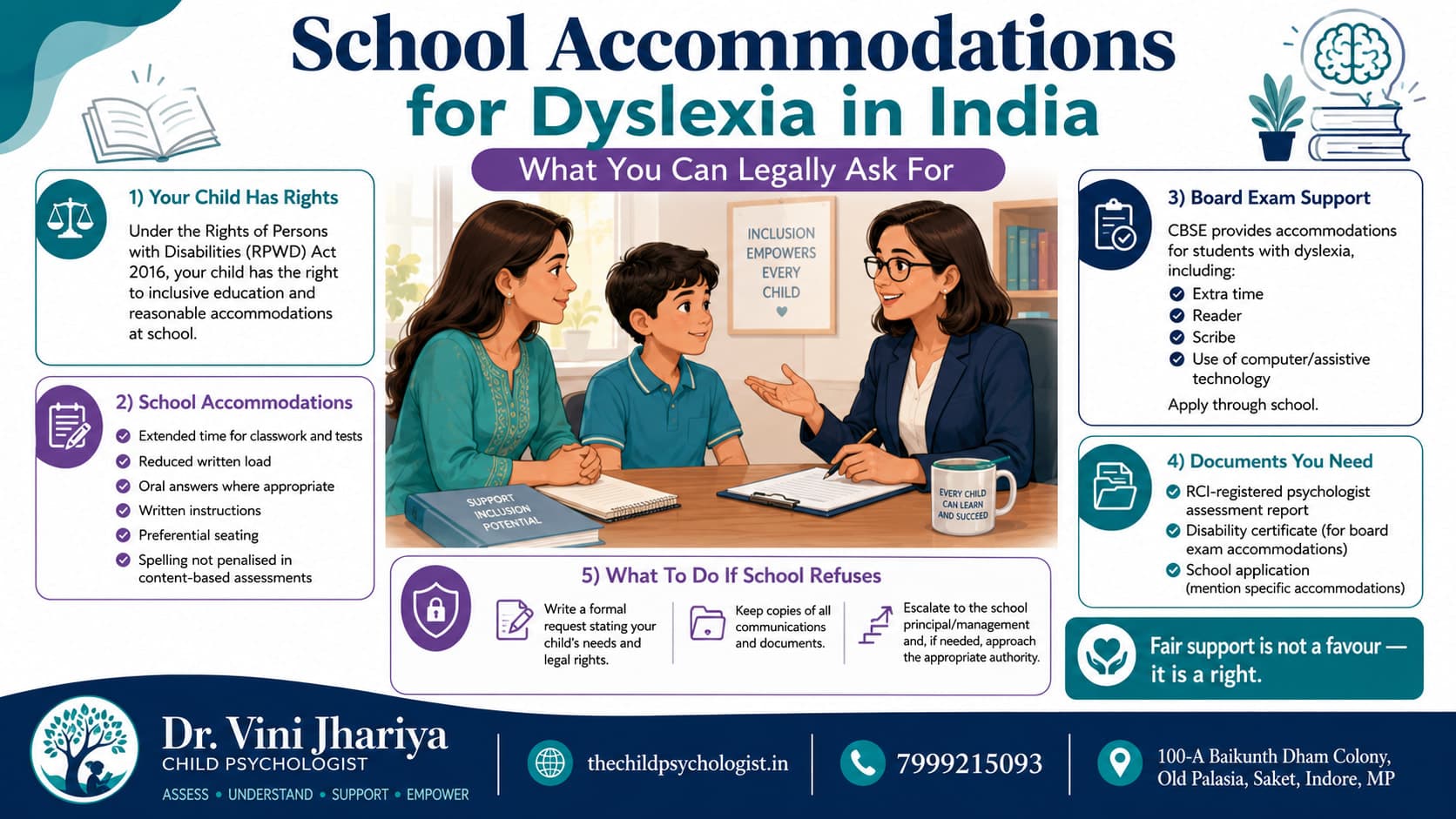
Specific Learning Disability — which includes dyslexia — is explicitly listed as a recognised disability under the Rights of Persons with Disabilities Act 2016.
Section 16 — right to inclusive education:
Every child with a disability has the right to education in an inclusive environment, with reasonable accommodation, individual education plans, and support services.
Section 31 — non-discrimination
Educational institutions cannot discriminate against students with disabilities. Refusing accommodation is a form of discrimination.
In plain language: your child with a dyslexia diagnosis has a legal right to reasonable accommodations in their school and in their examinations. The school's claim that they cannot make exceptions is not only incorrect — it is a statement that they are in violation of Indian law.
Section 01
What Reasonable Accommodation Means for Dyslexia
Classroom accommodations
Extended time for all written tasks — classwork, assignments, internal assessments
Permission to give oral answers in place of written ones where appropriate
Reduced written homework load — quality over quantity
Written instructions alongside verbal ones
Access to audiobooks or text-to-speech technology
Permission to type rather than handwrite where possible
Preferential seating — near the board, away from distraction
Spelling not penalised in subject assessments where the purpose is to assess content knowledge, not spelling ability
Examination accommodations within school:
Extended time — typically 25–50% additional time
Separate or quieter examination room
Reader — a person who reads the question paper to the child
Scribe — a person who writes what the child dictates
Use of a computer or assistive technology
CBSE Examination Accommodations — The Formal Process
Section 02
What CBSE provides for students with Specific Learning Disability:
Extra time — typically 20 minutes per hour (a 3-hour examination becomes 4 hours)
Scribe facility — a person who writes what the student dictates
Reader facility — a person who reads the question paper
Compensatory time if a scribe is used
Question paper in a specific font size if required
Documents required for CBSE accommodation application:
Assessment report from a qualified, RCI-registered psychologist confirming Specific Learning Disability
Disability certificate from a government hospital — required for board examination accommodations
Form submitted through the school — the school is the applicant, not the parent directly
Timeline — this is critical:
CBSE issues circulars annually with specific deadlines for accommodation applications — typically several months before the examination. Missing the deadline means missing the accommodation for that year. Contact your school's examination coordinator at the beginning of the academic year in which your child will appear for board examinations. Do not wait until the examination term.
The Disability Certificate — What It Is and How to Get It
The disability certificate is a government-issued document formally certifying your child's disability under the RPWD Act 2016. It is issued by government hospitals with psychiatry, neurology, or paediatric departments and is different from the private assessment report.
To get it: visit a government hospital in your district — district hospitals and medical colleges typically issue these. Bring your child's assessment report from the qualified psychologist. The hospital's medical board will review the report and issue the certificate specifying the disability type and severity.
Once obtained, apply for a UDID (Unique Disability ID) card at swavlambancard.gov.in — this centralises access to benefits and accommodations across India.
Step-by-Step — How to Request Accommodations
Compile your documentation — assessment report, accommodation recommendations from report, relevant RPWD Act sections, and disability certificate (for board exams)
Write a formal accommodation request letter — addressed to the school principal, listing each accommodation requested and its legal basis under the RPWD Act 2016
Send by email and retain the delivery receipt. If submitting a physical letter, retain a stamped copy.
Follow up in writing after any meeting — 'As discussed on [date], the following accommodations were agreed...' This creates a documented record.
If the school refuses or does not respond — escalate to the District Education Officer, then the State Commissioner for Persons with Disabilities
For board examinations — contact the school examination coordinator at the start of the academic year and confirm current deadlines and documentation requirements
A Note for Teachers Reading This
Do not penalise spelling in subject assessments where the purpose is to assess subject knowledge, not spelling ability. A geography essay should be marked on geographic understanding. Allow additional time for written tasks. Provide your notes or key words in advance where possible. Accept oral responses as an alternative to written ones for formative assessments. Never read a student's work aloud to the class without their permission — for a student with dyslexia, having their spelling errors made public is a significant source of shame.
If you need the assessment report, the documentation, or guidance to walk into that school office with confidence, reach out through thechildpsychologist.in or call 7999215093.
Section 03
If You Are in Indore or Nearby
If you are based in Indore, Bhopal, Ujjain, Dewas, or nearby areas, Dr. Vini Jhariya is available for in-person consultations. For families outside Indore — across India and internationally — online consultations are available through thechildpsychologist.in.
Address: 100-A Baikunth Dham Colony, Old Palasia, Saket, Indore, Madhya Pradesh
Phone: 7999215093
Website: thechildpsychologist.in
The Fourth Meeting Was Different
Priya went to that school office four times. The first three times, she left feeling like she had been asking for something she did not deserve. The fourth time, she left with a written accommodation plan — extended time on all assessments, access to a reader in examinations, spelling not penalised in subject tests.
Nothing had changed about Meera's dyslexia between the third visit and the fourth. What had changed was that Priya walked in knowing what she was entitled to ask for — and the school knew she knew.
The law has always been on your side. You just needed to know it was there. If you need the assessment report, the documentation, or the guidance to walk into that school office with confidence, reach out through thechildpsychologist.in or call 7999215093.
A note for parents
This article is educational guidance and does not replace an individual psychological consultation or assessment.
Questions and answers