
He Can Build Anything. He Cannot Read Three Lines.
Rajan's son Aditya was seven when the contradiction became impossible to ignore. At home, Aditya had built a functional pulley system out of household materials at age six. He could explain in detail how a jet engine worked — information he had gathered from watching videos and asking questions. He corrected adults when they made factual errors about history and science. He was, by every measure his father could observe, an exceptionally capable child.
He also could not read three consecutive lines without losing the thread, guessing at words incorrectly, and eventually putting the book down with an expression of quiet defeat.
'I don't understand,' Rajan said to me. 'How can someone who clearly has that kind of mind not be able to do something every other child in his class is doing?'
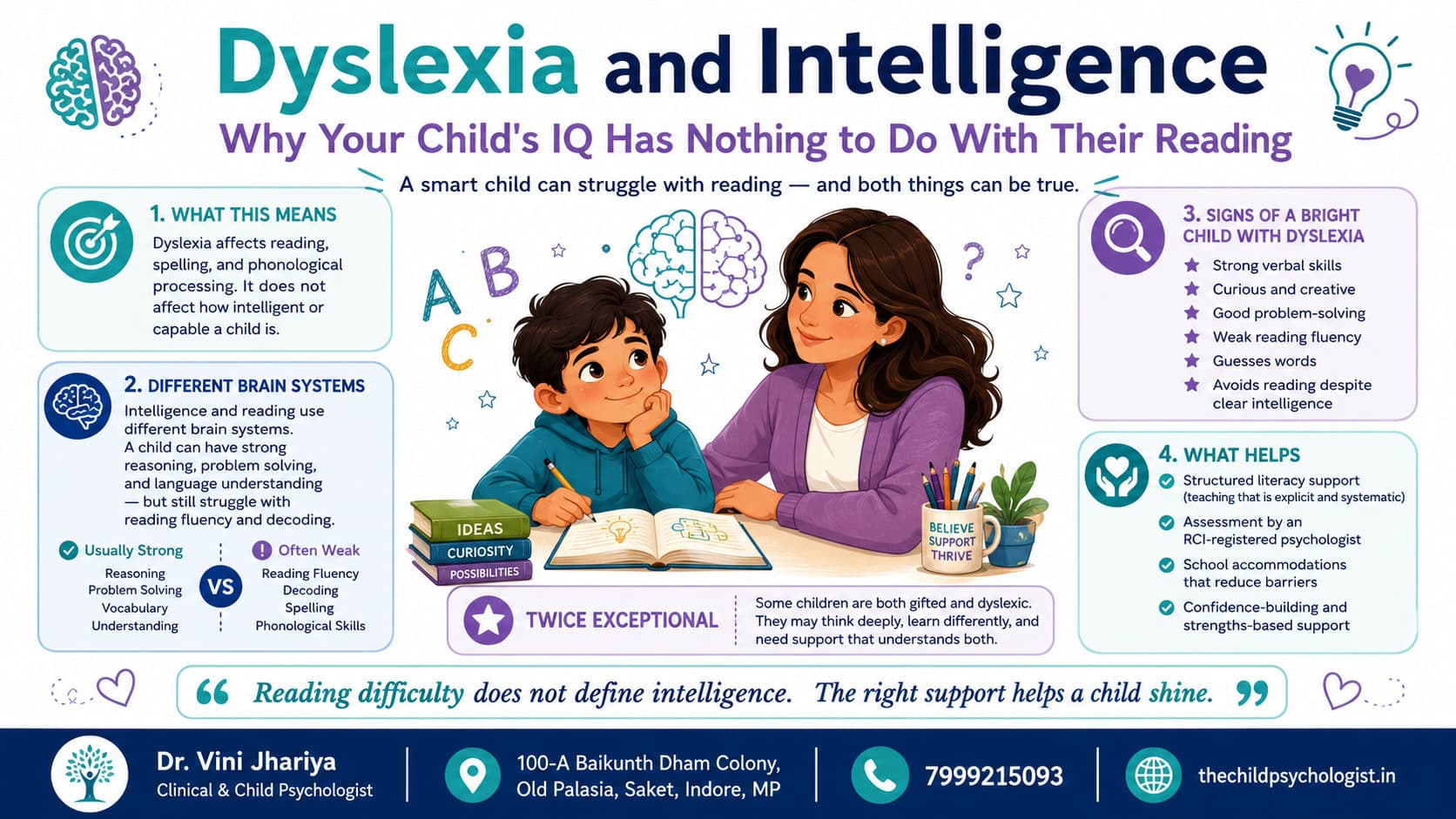
The answer — once you understand the neuroscience — is not only comprehensible but actually quite clarifying. Intelligence and reading ability are not the same thing. They do not live in the same part of the brain. They can be entirely dissociated from each other.
Intelligence and Reading — Two Different Neural Systems
Intelligence — in the broad sense of reasoning, problem-solving, knowledge acquisition, verbal comprehension, and creative thinking — is distributed across multiple brain networks, particularly the prefrontal cortex and parietal lobes.
Reading — specifically the decoding of written language — depends critically on a network in the left hemisphere that connects visual processing areas (recognising letter shapes), phonological processing areas (connecting those shapes to sounds), and language comprehension areas (deriving meaning from the sounds).
In dyslexia, the specific disruption is in the phonological processing component of this reading network. The visual system is typically intact. The language comprehension system — the part that understands language once it has been decoded — is typically intact or above average. The specific bottleneck is the phoneme-grapheme conversion system — the machinery that connects print to sound.
This machinery is entirely separate from the reasoning, problem-solving, and knowledge-acquisition systems that we associate with intelligence. A child can have exceptional reasoning capacity and a dysfunctional phoneme-grapheme conversion system simultaneously — because they are different parts of the brain.
Section 01
What the Research Says
Across large population studies, the distribution of IQ scores in individuals with dyslexia mirrors the general population. There are people with dyslexia at every point on the intellectual spectrum — from those with intellectual disabilities to those with profoundly high intelligence. What does correlate with dyslexia is not intellectual ability but phonological processing ability — the specific neurological function that reading requires.
Twice Exceptional — A Term Indian Parents Need to Know
'Twice exceptional' — sometimes written as 2e — refers to children who are both gifted (intellectually) and have a learning disability or neurodevelopmental difference. A child who is highly intelligent and has dyslexia is twice exceptional. This concept is not well known in India — and this invisibility has real consequences.
Twice-exceptional children are frequently missed on both counts. Their giftedness is masked by their learning disability — teachers see struggling, not brilliance. Their learning disability is masked by their giftedness — the child's intelligence compensates sufficiently that the reading difficulty does not produce the severity of underperformance that would trigger a referral. They exist in a difficult middle ground: too capable to be identified through the disability pathway, too disabled to be recognised through the gifted pathway.
Section 02
Why High Intelligence Makes Dyslexia Harder to Identify
A highly intelligent child with dyslexia uses their cognitive resources to compensate for their phonological processing difficulty. They use context, vocabulary, and world knowledge to predict and guess at words rather than decoding them phonologically. They use their excellent memory to memorise common words by sight. They use their strong oral comprehension to make up for what their decoding misses.
From the outside, this looks like functional — if slow — reading. What is invisible is the enormous cognitive effort required to maintain this compensatory performance, and the fact that as texts become longer, more complex, and less predictable, the compensation strategies begin to fail. By secondary school, the gap between the child's intellectual ability and their reading and writing performance often becomes too large to bridge through compensation — and the difficulties become visible precisely when the academic stakes are highest.
The Cognitive Profile of a Child With High IQ and Dyslexia
High scores on
Verbal Comprehension — vocabulary, verbal reasoning, and language understanding are strong
Fluid Reasoning — ability to solve novel problems and identify patterns is intact or above average
Low scores on
Phonological processing — the core dyslexia indicator
Rapid automatised naming — speed of visual-to-verbal connection
Section 03
Reading fluency and spelling — the academic consequences of phonological processing difficulty
This pattern — high reasoning and comprehension alongside low phonological processing and reading scores — is the neurological signature of a twice-exceptional child. It confirms that the reading difficulty is not explained by low intelligence. It is an independent, specific processing difficulty occurring in the context of intellectual strength.
Section 04
Why This Matters — The Giftedness That Gets Lost
Academic assessments, examinations, and school reports are almost entirely mediated through reading and writing. A child who cannot express their intelligence through written language will systematically underperform on every measure the school uses to assess capability. The school's picture of them — built from marks, written work, and reading groups — will be consistently below their actual ability.
The gifted child with dyslexia often moves through school without ever having their intellectual capacity recognised, documented, or built upon. Their giftedness is invisible — not because it does not exist, but because the system has no way of seeing it through the filter of written language.
Section 05
What Support Looks Like for a Twice-Exceptional Child
For the dyslexia:
Structured literacy intervention — explicit, systematic phonics teaching
School accommodations — extended time, scribing, reader facilities
Examination board accommodations under RPWD Act 2016
Assistive technology — text-to-speech and speech-to-text tools that allow the child's intelligence to be expressed without the phonological processing bottleneck
For the giftedness:
Enrichment, challenge, and opportunities to engage with material at an appropriate intellectual level
A twice-exceptional child who receives only remediation — whose school experience is entirely about their disability — is being as poorly served as one who receives only challenge without support
For the emotional consequence:
Direct therapeutic attention for the accumulated shame, disrupted self-concept, and belief that they are simultaneously too clever and too stupid
If your child shows the combination of evident intelligence and reading or writing difficulty, reach out through thechildpsychologist.in or call 7999215093.
Section 06
If You Are in Indore or Nearby
If you are based in Indore, Bhopal, Ujjain, Dewas, or nearby areas, Dr. Vini Jhariya is available for in-person consultations. For families outside Indore — across India and internationally — online consultations are available through thechildpsychologist.in.
Address: 100-A Baikunth Dham Colony, Old Palasia, Saket, Indore, Madhya Pradesh
Phone: 7999215093
Website: thechildpsychologist.in
Both Things Were Always True
Rajan had been carrying two beliefs simultaneously and could not reconcile them: his son was exceptionally capable, and his son could not read. Neither was wrong. Both were true — because they were describing different neural systems, different capacities, different parts of the same remarkable brain. Aditya was assessed. The report confirmed strong intellectual ability alongside significant phonological processing difficulty. Both things were always true. It just took the right assessment to make both visible. Reach out through thechildpsychologist.in or call 7999215093.
A note for parents
This article is educational guidance and does not replace an individual psychological consultation or assessment.
Questions and answers