He Reads With Me Every Night. Nothing Is Getting Better.
Anita had been reading with her son Dev every night for two years. She had bought phonics workbooks. She had downloaded reading apps. She had sat beside him through tears — his and, on some nights, hers — as he struggled through sentences that his classmates were reading fluently. His teacher had suggested more practice. His aunt had suggested it was laziness. His grandfather had suggested reading in Hindi instead of English, since English was a second language. She had tried. He struggled in Hindi too. By the time she came to me, Dev had developed a profound resistance to any task involving text and had begun to describe himself as stupid.
'Is this dyslexia?' she asked me. 'And how do I know?'
The answer begins with understanding what dyslexia actually looks like — because most parents know only one of its signs.
Section 01
What Dyslexia Is — The One-Paragraph Version
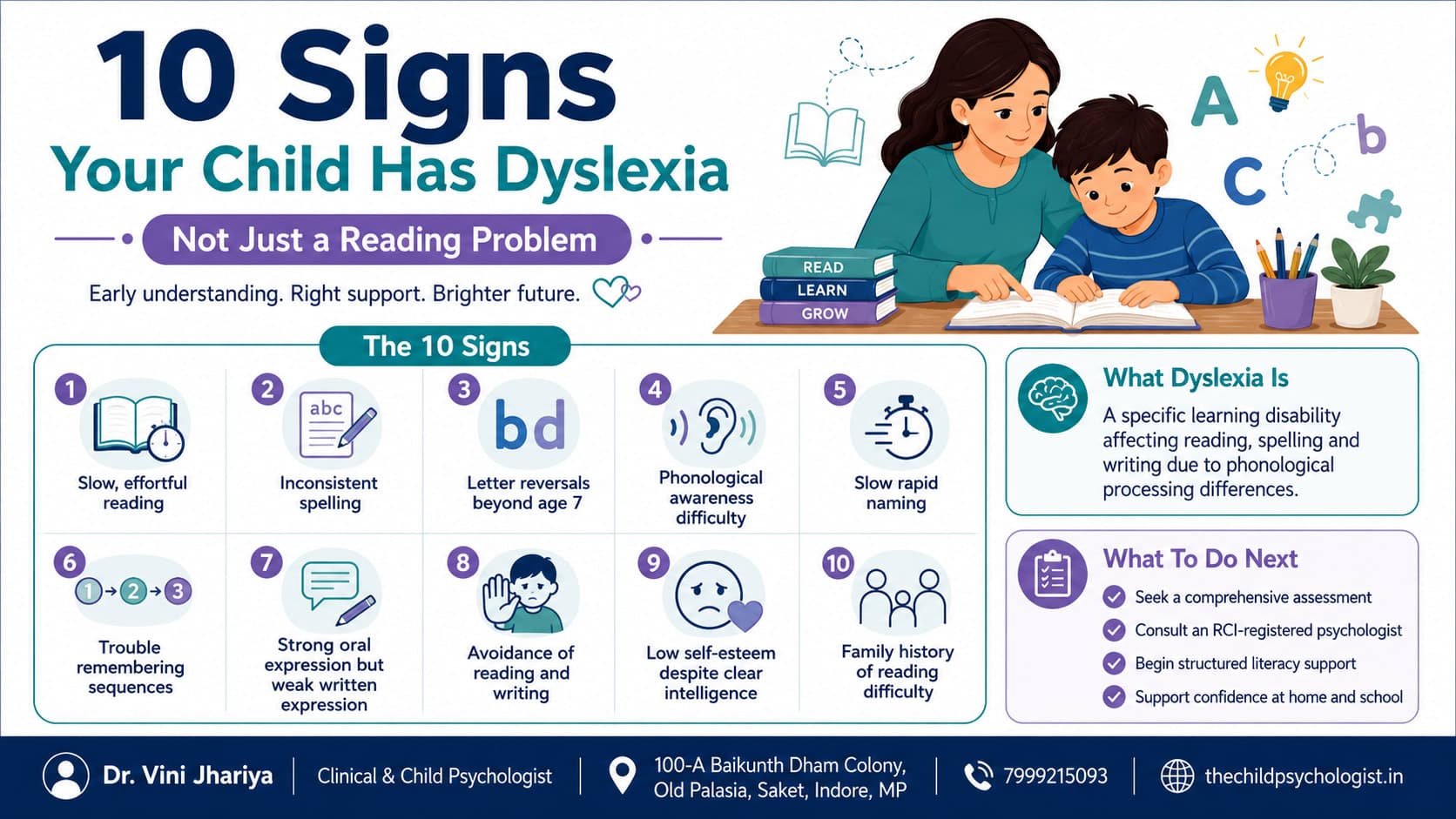
Dyslexia is a specific learning disability characterised by difficulty with accurate and fluent word reading and spelling, resulting from differences in phonological processing — the ability to connect letters to their sounds and manipulate the sounds of spoken language. It is not caused by low intelligence, inadequate teaching, or lack of effort. It is neurological, it is heritable, and it is present across all languages and writing systems — including Hindi and other Indian scripts.
The 10 Signs
Sign 1: Reading That Is Slow, Effortful, and Inaccurate
The child reads slowly, losing their place frequently, guessing at words based on the first letter or context rather than sounding them out, and making substitution errors. By the end of a paragraph, they cannot tell you what it was about — because the cognitive effort of decoding the words has used all available resources. Key signal: reading practice for one to two years with no meaningful improvement.
Sign 2: Spelling That Is Inconsistent and Phonetically Unusual
Children with dyslexia spell phonetically but inaccurately — 'frend' for friend, 'wus' for was, 'sed' for said. More diagnostically significant: the child may spell the same word differently in the same piece of writing. In Hindi: matra placement errors and conjunct consonant confusion are characteristic.
Sign 3: Letter and Number Reversals Persisting Beyond Age 7
Reversals — confusing b and d, p and q, was and saw — are developmentally normal up to approximately age seven. When reversals persist beyond age seven and are accompanied by other reading and spelling difficulties, they become clinically significant. The child recognises the error when it is pointed out but does not catch it independently.
Sign 4: Difficulty With Phonological Awareness Tasks
Phonological awareness — the ability to hear, identify, and manipulate the sounds of spoken language — is the neurological core of dyslexia. Signs include: difficulty learning nursery rhymes, difficulty identifying rhymes, difficulty blending sounds into words, difficulty clapping syllables, difficulty changing one sound in a word. This often predates formal reading instruction. Word games and rhyming activities that peers find straightforward are genuinely hard.
Sign 5: Slow Rapid Naming — Knows It But Cannot Say It Quickly
Rapid automatised naming (RAN) measures how quickly the child can name a series of familiar items — letters, numbers, colours, objects. Children with dyslexia are significantly slower than peers at rapid naming tasks, even when they know the names perfectly well. The difficulty is not in the knowledge but in the speed of retrieval. Times tables, days of the week, months of the year — sequential verbal retrieval is difficult.
Sign 6: Difficulty Remembering Sequences
Dyslexia frequently involves difficulty remembering sequences — not as a general memory problem, but specifically for ordered verbal information. The months of the year, the days of the week, the alphabet in order, multiplication tables — despite repeated drilling, these remain unreliable. The child can remember stories, conversations, and events with no difficulty — sequential verbal memory is the specific affected area.
Sign 7: Strong Oral Expression — Weak Written Expression
A child with dyslexia may be an articulate, verbally sophisticated, highly expressive speaker — and produce written work that is fragmented, poorly spelled, and lacking the ideas and vocabulary that their speech demonstrates. The gap between oral and written expression is the diagnostic signal. Writing requires the phonological and orthographic processing that dyslexia impairs; speech does not.
Sign 8: Avoidance of Reading and Writing — Not Laziness, But Self-Protection
By the time many children with dyslexia are identified, they have developed significant avoidance of reading and writing tasks. This is self-protection — a rational response to repeated failure. The avoidance is a consequence of the underlying difficulty, not the underlying difficulty itself. The child who 'forgets' reading homework and becomes distressed at the prospect of written tasks is communicating that these tasks have become associated with shame and failure.
Sign 9: Low Self-Esteem and Academic Self-Belief Despite Evident Intelligence
Children who struggle with reading while their peers progress, who are told to try harder, who cannot produce written work that reflects their intelligence, develop a specific kind of low self-esteem — the belief that they are less capable than they appear. 'I'm stupid.' 'I'm bad at school.' 'Reading is not for me.' These are not accurate self-assessments — they are the accumulated evidence of years of unexplained difficulty. The child is clearly intelligent; they have simply stopped believing that effort will produce improvement.
Sign 10: A Family History of Reading or Spelling Difficulties
Dyslexia is highly heritable. A child with a parent or sibling with dyslexia has a significantly higher likelihood of dyslexia than the general population. In Indian families, a family history of reading difficulty is frequently present but not recognised — because the parent or grandparent who struggled with reading may have left school early or chosen a profession that did not require extensive reading. The family history is there; it has just never been given a name.
Section 02
How Dyslexia Presents in Indian Children Specifically
Struggles in both English AND Hindi — not just a second-language issue
Hindi medium schools: matra placement errors, conjunct consonant confusion, slow reading fluency even when Devanagari spelling appears closer to pronunciation
Difficulty attributed to English being a second language — but first language literacy is also affected
Extra tuition for six months or more with no improvement in reading or spelling
Performs better in oral examinations or one-to-one settings than in written class tests
Section 03
What Dyslexia Does Not Look Like — Common Myths
Dyslexia is not seeing letters backwards — it is a phonological, not visual, difference
Dyslexia is not a sign of low intelligence — it occurs at every intellectual level
Dyslexia does not go away with more reading practice — structured literacy intervention is what helps
Dyslexia is not more common in boys — equal prevalence, boys referred more often due to referral bias
Section 04
What to Do If Several Signs Apply to Your Child
If five or more of the signs above apply to your child — particularly if they are present consistently across home and school, and if your child has not responded to additional reading practice — a comprehensive psychoeducational assessment is the appropriate next step. You do not need certainty to seek an assessment. You need concern — and your concern, as the person who knows your child best, is a valid and important clinical input.
If several of these signs apply to your child, reach out through thechildpsychologist.in or call 7999215093.
Section 05
If You Are in Indore or Nearby
If you are based in Indore, Bhopal, Ujjain, Dewas, or nearby areas, Dr. Vini Jhariya is available for in-person consultations. For families outside Indore — across India and internationally — online consultations are available through thechildpsychologist.in.
Address: 100-A Baikunth Dham Colony, Old Palasia, Saket, Indore, Madhya Pradesh
Phone: 7999215093
Website: thechildpsychologist.in
Dev Is Not Stupid
Dev was assessed three weeks after Anita's first call. The report confirmed dyslexia — significant phonological processing difficulty with intact cognitive ability. The psychologist's feedback session included this sentence, which Anita asked to have repeated so she could write it down: 'Dev's intelligence and his reading difficulty are completely separate. His brain is very capable. The specific pathway that converts print to sound is the one that needs targeted support.' She took that sentence home. She read it to Dev. He was quiet for a moment. Then he asked: 'So I'm not stupid?' 'You are not stupid. Your brain just needs a different kind of teaching.' Reach out through thechildpsychologist.in or call 7999215093.
A note for parents
This article is educational guidance and does not replace an individual psychological consultation or assessment.
Questions and answers