The Landscape Nobody Prepares You For
When Deepa finally decided to seek professional help for her eight-year-old son, she spent two weeks on Google before making a single call. She found a counsellor who described herself as a 'child specialist.' She found a 'child development expert' who offered online consultations and sold a parenting programme alongside them. She found three people describing themselves as psychologists whose qualifications she could not verify. She found a psychiatrist who could prescribe medication but whose website did not mention assessment. She found a clinical psychologist at a hospital who had a six-month waiting list. And she found a 'child psychologist' whose Instagram account had 200,000 followers but whose formal credentials were nowhere on her website.
'I don't know who to go to,' she told a friend. 'I don't know how to tell the difference between any of them.'
This is one of the most common experiences parents describe. The child psychology landscape in India is not well-regulated from a consumer's perspective. Parents who do not know what to look for can easily end up with a practitioner who is warm, well-intentioned, and entirely unqualified to assess or treat the condition their child has. This blog gives you the seven questions that protect you — and your child.
First — The Professional Landscape in India
Clinical Psychologist
A psychologist with a postgraduate degree (M.Phil or PhD) in clinical psychology from an RCI-recognised institution, registered with the Rehabilitation Council of India (RCI). The highest clinical training standard for psychological assessment and therapy in India. Can assess, diagnose using clinical tools, and treat psychological and neurodevelopmental conditions.
Educational Psychologist
A psychologist specialising in learning, development, and educational contexts. May or may not hold RCI registration. Well-positioned for psychoeducational assessments — dyslexia, ADHD, learning disabilities.
Counsellor or Therapist
Training ranges from three-month certificate programmes to full master's degrees, depending on the individual. Counsellors are generally not trained to conduct psychological assessments or diagnose neurodevelopmental conditions. The term is broadly used and loosely regulated in India.
Child Psychiatrist
A medical doctor who has specialised in psychiatry and further in child and adolescent psychiatry. Can prescribe medication. Conducts clinical assessments but typically not the comprehensive cognitive and psychoeducational batteries that a psychologist conducts.
Developmental Paediatrician
A paediatrician with additional training in developmental medicine. Primarily assesses developmental delays and can diagnose autism and ADHD using clinical tools. Does not conduct cognitive or psychoeducational assessments.
The practical implication:
If your concern is autism, ADHD, dyslexia, learning disabilities, or a comprehensive psychological assessment — you need a clinical or educational psychologist with RCI registration and specific expertise in child assessment. A counsellor or psychiatrist alone is not sufficient for these purposes.
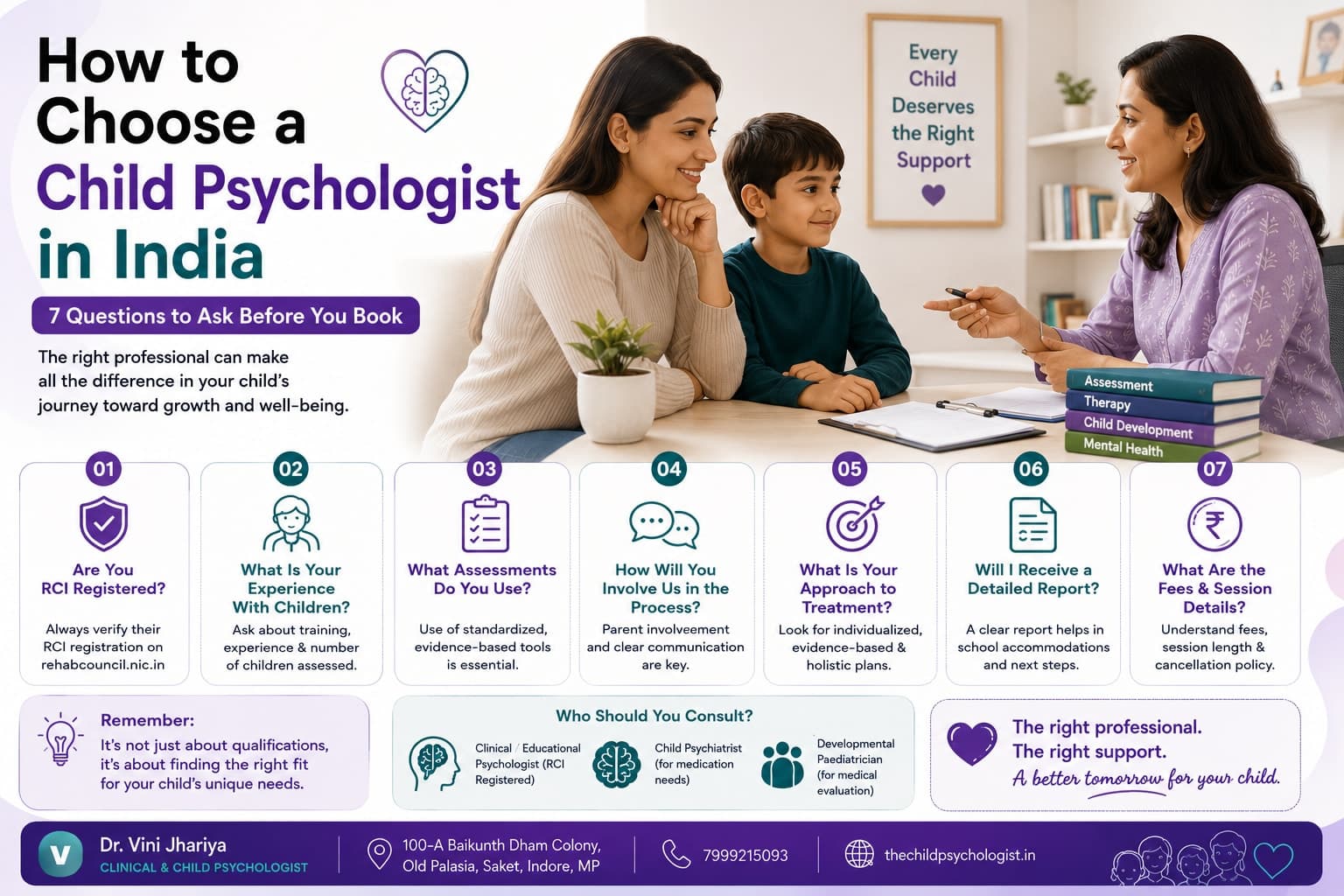
The 7 Questions to Ask Before You Book
Question 1: Are You RCI Registered — and Can I Verify It?
The Rehabilitation Council of India (RCI) is the statutory body that regulates professionals working with persons with disabilities in India — including psychologists who assess and work with children with neurodevelopmental conditions. RCI registration requires a minimum of an M.Phil in Clinical Psychology from an RCI-approved institution.
Why this matters: a report from an unregistered practitioner will not be accepted by CBSE or other examination boards for accommodation applications. It means the professional has not met the minimum training standard required for statutory recognition.
How to verify: ask for the RCI registration number and verify it on the RCI website (rehabcouncil.nic.in). A genuine registration can be confirmed in minutes.
Red flag: any hesitation, evasion, or inability to provide an RCI registration number.
Question 2: What Is Your Specific Training and Experience With Children?
A psychologist with excellent training and experience in adult depression may have limited competence in assessing a seven-year-old for ADHD. The question is not just 'are you a psychologist' — it is 'are you a psychologist with specific training and substantial experience in assessing and treating children with the presentation my child has?'
Specific training to look for: postgraduate training in child and adolescent psychology, supervised assessment experience with children using standardised tools (WISC, CARS, ADOS, BRIEF, Conners), specific experience with autism, ADHD, or learning disabilities.
What to ask: 'How many children with [autism / ADHD / dyslexia] have you assessed? What assessment tools do you use?'
Red flag: vague answers, inability to name specific assessment tools, or a practice that primarily serves adults.
Question 3: What Does the Assessment Process Look Like — Specifically?
A comprehensive child psychological assessment is not a single appointment. It should involve multiple sessions, multiple types of information gathering, and a written report.
Ask specifically: How many sessions does the assessment involve? What tools will be used and what does each measure? Will you gather information from school as well as from the family? How long after the final session will the report be ready? Will there be a feedback session where the report is explained to me?
What a good answer looks like: two to three assessment sessions, parent interview, standardised tools named specifically, school information gathered, written report within two weeks, and a feedback session included.
Red flag: a single session that produces a diagnosis. A report produced immediately after one appointment. No mention of school information or a feedback session.
Question 4: What Will the Report Include — and Where Will It Be Accepted?
If you are seeking an assessment for school accommodations or examination board accommodations, the report must meet specific requirements.
Ask directly: Will the report include a formal diagnosis using DSM-5 or ICD-11 criteria? Is the report accepted by CBSE / ICSE for accommodation applications? Does the report include specific recommendations for school and home?
What a good answer looks like: a comprehensive report with diagnostic conclusions, cognitive profile, standardised scores, and specific recommendations — accepted by CBSE and other boards.
Red flag: uncertainty about whether the report meets board requirements, or vague promises that 'most schools accept it.'
Question 5: Do You Work As Part of a Multidisciplinary Team?
For children with autism, ADHD, dyslexia, or other neurodevelopmental conditions, assessment is most useful when it informs a comprehensive support plan — not when it exists as a standalone document.
What to ask: 'Do you work with other specialists? If my child needs speech therapy or OT following the assessment, can you coordinate referrals? Do you liaise with schools?'
What a good answer looks like: a clear description of how the psychologist coordinates with other professionals and how they support families in translating assessment findings into actual support.
Red flag: no mention of coordination with other professionals, no referral network, a purely assessment-focused practice with no support for what comes after.
Question 6: What Happens After the Assessment — What Support Do You Offer?
The assessment is the beginning — not the end. A good child psychologist should tell you clearly what happens after the report is handed over.
Ask specifically: Do you offer follow-up consultations to discuss the report and recommendations? Do you offer therapy or coaching directly, or refer elsewhere? Can you help me communicate the findings to the school? How do I reach you if I have questions after receiving the report?
What a good answer looks like: a structured post-assessment pathway — feedback session, follow-up consultation, school liaison, and clear referral pathways for any therapy recommended.
Red flag: no follow-up offered, report handed over with no explanation, no support for the next steps the report recommends.
Question 7: Can You Tell Me About Your Approach — and Does It Match What My Child Needs?
Every psychologist has a clinical philosophy — an approach to assessment and intervention that reflects their training and values.
Ask: 'How do you approach assessment — is it purely clinical or do you also consider the child's emotional experience?' 'What is your philosophy around diagnosis?' 'How do you involve parents in the assessment and intervention process?'
What a good answer looks like: an approach that is evidence-based, child-centred, family-inclusive, and treats the diagnosis as a tool for understanding rather than a verdict.
Red flag: a purely clinical approach with no mention of the child's emotional experience, a dismissive attitude toward parent input.
The Red Flags Summary
Cannot provide or resists verifying RCI registration number
Qualifications are vague, unverifiable, or primarily in adult psychology
The assessment is a single session with an immediate diagnosis
The report is not accepted by CBSE or examination boards
Works in complete isolation without any multidisciplinary connection
Promises rapid, dramatic results
Cannot clearly explain what tools they use or what the assessment involves
Online presence is primarily marketing rather than clinical content
Section 01
What a Genuinely Qualified Specialist Child Psychologist Looks Like
Has an M.Phil or PhD in Clinical Psychology from an RCI-recognised institution. Is registered with the RCI — verifiably. Has specific, substantial experience in child assessment for the conditions relevant to your child. Uses standardised, validated assessment tools. Conducts multi-session, multi-informant assessments. Produces comprehensive written reports accepted by schools and examination boards. Works within or in close collaboration with a multidisciplinary team. Offers a structured post-assessment pathway. Communicates in plain language that parents can understand. Has a clinical philosophy that is evidence-based, child-centred, and family-inclusive.
Dr. Vini Jhariya is a Clinical and Child Psychologist with RCI registration, over a decade of clinical experience, and specific expertise in autism, ADHD, dyslexia, and child developmental assessment. If you would like to ask the seven questions — and any others — reach out through thechildpsychologist.in or call 7999215093.
Section 02
If You Are in Indore or Nearby
If you are based in Indore, Bhopal, Ujjain, Dewas, or nearby areas, Dr. Vini Jhariya is available for in-person consultations. For families outside Indore — across India and internationally — online consultations are available through thechildpsychologist.in.
Address: 100-A Baikunth Dham Colony, Old Palasia, Saket, Indore, Madhya Pradesh
Phone: 7999215093
Website: thechildpsychologist.in
Deepa Made Her Decision
Deepa eventually booked an appointment. Not with the Instagram influencer. Not with the unverifiable 'child specialist.' Not with the first name on Google. She used the seven questions. One practitioner could not name a single assessment tool. Another did not have RCI registration. A third offered a diagnosis after forty minutes.
The fourth — who answered every question clearly, who welcomed verification, who explained the assessment process in detail and offered a structured post-assessment pathway — was who she booked.
'I felt like I was in the right place,' she told me later. 'Not because the office was fancy or the website was polished. Because she could answer every question I asked.'
That is what you are looking for. A practitioner who welcomes your questions — because a qualified specialist has nothing to hide. Reach out through thechildpsychologist.in or call 7999215093.
A note for parents
This article is educational guidance and does not replace an individual psychological consultation or assessment.
Questions and answers