Section 00
She Has Been Anxious Since She Was Eight
Nisha was sixteen when her mother brought her to me — not for ADHD, but for treatment-resistant anxiety and low self-esteem. She had been seeing a counsellor since she was twelve. She had tried two different therapists. She had been on anxiety medication for eighteen months. None of it had produced meaningful improvement.
Twenty minutes into my assessment conversation with Nisha, I was already thinking about ADHD. Forty minutes in, I was fairly certain. Three weeks later, after a comprehensive assessment, the report confirmed it: ADHD predominantly inattentive presentation, with co-occurring anxiety that had developed as a secondary consequence of years of unidentified ADHD.
She was sixteen. She had been struggling since at least age eight. Eight years of the wrong explanation, the wrong treatment, and the accumulated emotional cost of not understanding why everything was harder for her than it seemed for everyone else.
Section 01
Why ADHD in Teenage Girls Looks Different
The masking is more sophisticated:
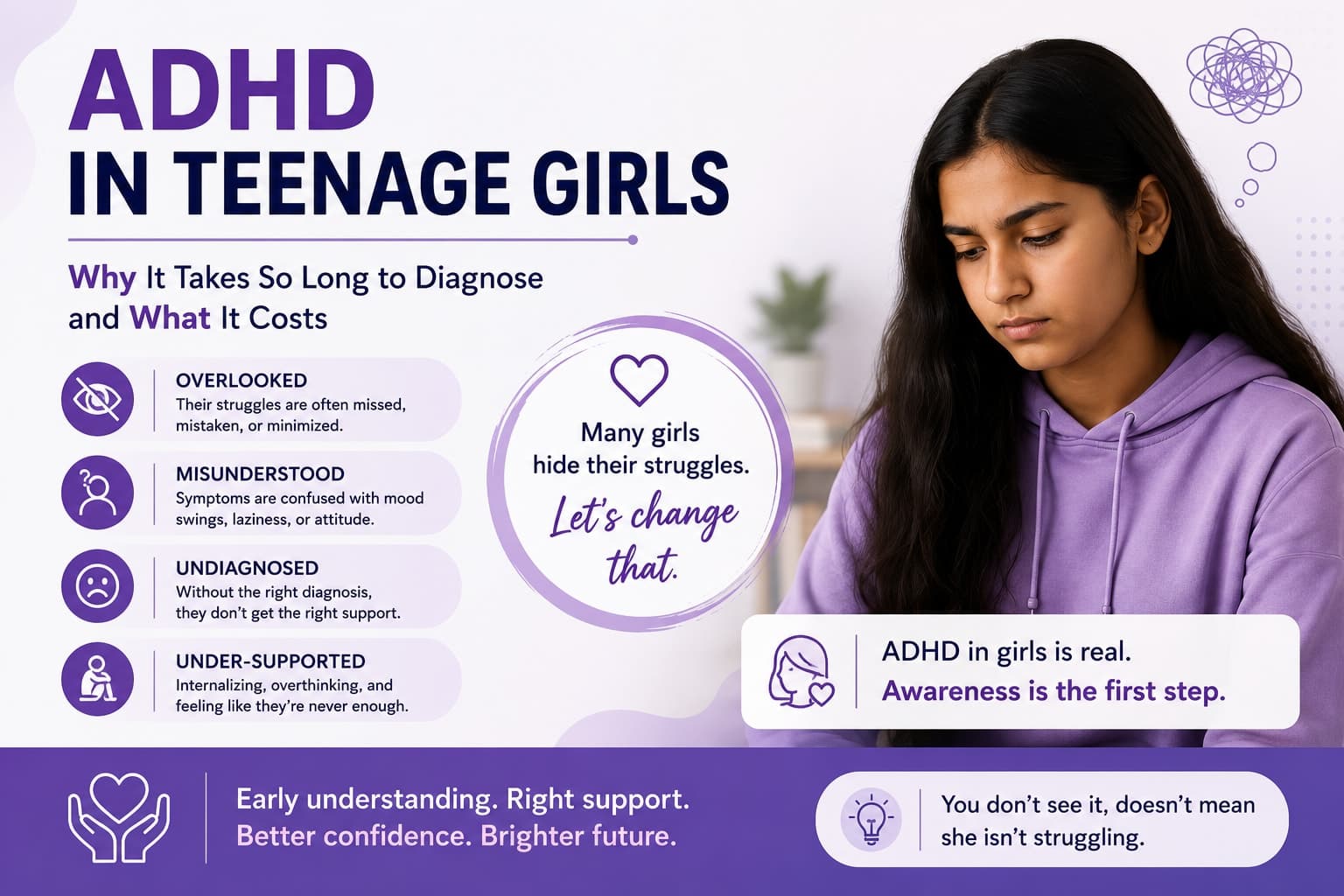
By adolescence, a girl with unidentified ADHD has had years of practice compensating, copying, and hiding her difficulties. From the outside, she looks like an anxious, average-achieving teenager who is being too hard on herself. From the inside, she is running on compensatory strategies that are beginning to crack under the weight of increasing academic and social demands.
The academic demands have escalated:
Secondary school and board exam preparation require precisely the executive function skills that ADHD most significantly impairs — sustained independent study, long-term project management, exam preparation over weeks and months. Girls who managed adequately in primary school often begin to fail visibly in secondary school.
Social complexity has increased:
Adolescent social dynamics — particularly for girls — are more complex, more intense, and more emotionally loaded than childhood friendships. Girls with ADHD find this terrain increasingly difficult to navigate without it showing.
The emotional dysregulation is more visible:
Adolescent emotional intensity combines with ADHD-related emotional dysregulation to produce reactions described as 'dramatic,' 'oversensitive,' or 'unstable.' These girls are frequently referred for counselling when the underlying cause is neurological.
Section 02
The Hormonal Dimension Nobody Talks About
Oestrogen has a significant effect on dopamine function. As oestrogen fluctuates through the menstrual cycle during adolescence, so does the efficiency of the dopamine system — and with it, the severity of ADHD symptoms. Research shows many girls with ADHD experience significant symptom worsening in the premenstrual phase — greater inattention, emotional dysregulation, greater executive function difficulty — that is frequently attributed to PMS rather than ADHD exacerbation driven by hormonal change. This should be raised explicitly with any prescribing doctor.
Section 03
The Emotional Cost — What Years of Being Missed Does
Chronic shame:
A girl who has struggled academically and socially for years accumulates shame from thousands of small moments where she was told her failures are her fault. By the time ADHD is identified, most late-diagnosed adolescent girls have a deeply entrenched shame narrative about themselves.
Anxiety as a secondary consequence:
The anxiety that most of these girls are referred for is very often a secondary consequence of ADHD, not a co-primary diagnosis. Treating the anxiety without addressing the ADHD is treating the smoke without the fire. When ADHD is identified and appropriately supported, anxiety frequently reduces significantly without specific anxiety treatment.
Exhaustion from masking:
By adolescence, the compensatory strategies a girl with unidentified ADHD has developed are consuming a significant proportion of her cognitive and emotional resources. She is working harder than anyone around her realises — and getting less return on that effort than her peers.
Section 04
Signs That Suggest ADHD Should Be Investigated
Years of academic underperformance despite evident intelligence
Chronic disorganisation that has not responded to organisational coaching
Difficulty initiating tasks — particularly for studying and independent work
Significant emotional dysregulation — described as 'too sensitive,' 'dramatic,' or 'overreacting'
Anxiety that is long-standing, treatment-resistant, or worsens significantly premenstrually
A pattern of starting things with enthusiasm and abandoning them
Social difficulties — friendships that ended due to forgetting or social missteps
Exhaustion disproportionate to apparent activity level
A strong sense of self-failure that does not respond to reassurance or therapy
Section 05
What to Say to a Teenage Girl Who Has Just Received a Late ADHD Diagnosis
'This diagnosis does not change who you are. It explains why some things have been so much harder for you than they looked to be for other people. All the times you were told you just needed to try harder — that was wrong. Not because you didn't try — you tried enormously. But because the trying was happening with a tool that was not working efficiently. Now we know. And now we can actually help.'
*If your teenage daughter has been struggling for years and ADHD has never been seriously considered, reach out through thechildpsychologist.in or call 7999215093.*
Section 06
If You Are in Indore or Nearby
If you are based in Indore, Bhopal, Ujjain, Dewas, or nearby areas, Dr. Vini Jhariya is available for in-person consultations. For families outside Indore — across India and internationally — online consultations are available through thechildpsychologist.in.
Address: 100-A Baikunth Dham Colony, Old Palasia, Saket, Indore, Madhya Pradesh
Phone: 7999215093
Website: thechildpsychologist.in
Section 07
She Was Not Broken. She Was Not Seen.
Nisha came back four months after her assessment. She had started medication. She had begun executive function coaching. Her school had been given an accommodation plan. 'I spent eight years thinking I was the problem,' she said. 'It turns out I just didn't have the right map.' If your teenage daughter has been struggling and something in this story is familiar, reach out through thechildpsychologist.in or call 7999215093.
A note for parents
This article is educational guidance and does not replace an individual psychological consultation or assessment.
Questions and answers