The School Said 'Get an Assessment.' Now What?
Rekha had been putting it off for six weeks. The school counsellor had been gentle but clear — her son Kabir, now in Class 4, was struggling with reading and writing in a way that suggested dyslexia, and a formal assessment would be needed before any academic accommodations could be put in place. She opened her laptop and found a confusing mix of websites listing tests she had never heard of, clinics with no information about what they actually did. She closed the laptop. She waited six more weeks.
When she finally called me, the first thing she said was: 'I just need someone to tell me what this actually is. What happens. Who does it. What the piece of paper at the end actually means.'
Section 01
What Dyslexia Is — Briefly
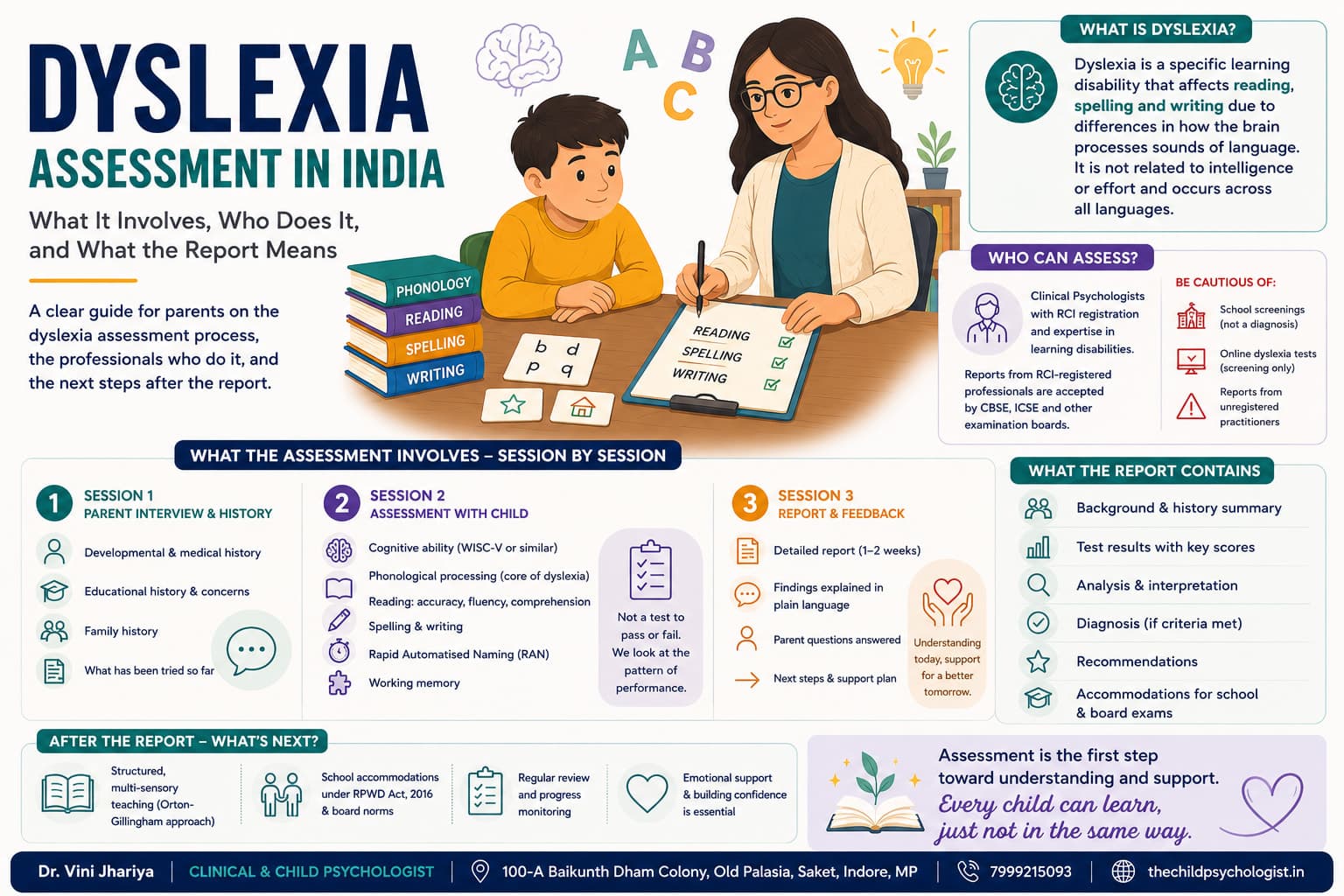
Dyslexia is a specific learning disability that primarily affects the ability to read, spell, and write — not due to low intelligence, inadequate teaching, or lack of effort, but due to differences in how the brain processes the sounds of language. The core difficulty is phonological processing — the ability to hear, identify, and manipulate the individual sounds (phonemes) that make up words. This is the neurological foundation of reading. Dyslexia is estimated to affect approximately 10–15% of the population globally and occurs across all languages — including Hindi and other Indian scripts.
Who Is Qualified to Assess for Dyslexia in India
Clinical Psychologists with RCI registration
The Rehabilitation Council of India (RCI) is the statutory body regulating professionals working with persons with disabilities. A clinical or educational psychologist with RCI registration and specific expertise in learning disabilities is the appropriate assessor for a comprehensive dyslexia evaluation. Reports from RCI-registered psychologists are accepted by CBSE, ICSE, and state examination boards for accommodation applications.
What to be cautious about:
School-based 'dyslexia screening' — identifies children who need further assessment but does not constitute a diagnosis
Online dyslexia tests — screening tools, not diagnostic assessments
Reports from unregistered practitioners — will not be accepted by CBSE or other examination boards
Section 02
What a Dyslexia Assessment Involves — Session by Session
Session 1 — Parent Interview and History
A detailed conversation covering developmental history — pregnancy and birth, developmental milestones, when your child first walked, talked, and began to read. Educational history — which schools attended, how they have performed, any previous assessments. Family history — dyslexia has a significant genetic component. Current concerns — specific difficulties the child is having and what has already been tried. Medical history — hearing and vision checked, any significant illnesses or medications.
Session 2 — The Assessment with Your Child
The assessment is not a competitive test — there is no pass or fail. The pattern of performance across tasks is what matters. A comprehensive dyslexia assessment typically includes:
Cognitive ability assessment (WISC-V or similar) — measuring intellectual abilities across verbal comprehension, fluid reasoning, working memory, and processing speed
Phonological processing — tests of the child's ability to hear and manipulate the sounds of language (the core dyslexia assessment)
Section 03
Reading assessment — word reading accuracy, reading fluency, and reading comprehension assessed separately
Spelling and writing assessment
Rapid automatised naming (RAN) — how quickly the child can name a series of letters, numbers, colours, or objects — one of the most sensitive indicators of dyslexia
Working memory — particularly verbal working memory, frequently affected in dyslexia
Most children, once they settle into the session, find it less frightening than they anticipated. Breaks are built in. Tasks vary between more and less demanding.
Session 3 — Report and Feedback
After the assessment, the psychologist analyses the results and writes the report — typically within one to two weeks. A feedback session explaining the findings in plain language should be part of the process. This is the session Rekha had needed six weeks earlier.
Section 04
What the Dyslexia Assessment Report Contains
Reason for referral and background information:
A summary of the developmental and educational history gathered from the parent interview.
Test results — key things to look for:
A significant gap between cognitive ability scores and reading/spelling scores — the core indicator of specific learning disability
Low phonological processing scores — the neurological signature of dyslexia
Low RAN scores — strongly associated with dyslexia
Intact or above-average verbal comprehension — the child understands language well; the difficulty is specifically with print-to-sound conversion
Diagnosis
Whether findings meet criteria for Specific Learning Disability with impairment in reading (dyslexia), in written expression (dysgraphia), in mathematics (dyscalculia), or in combination. Severity specified as mild, moderate, or severe.
Recommendations
The most practically important section. Should include specific school accommodations, the type of remediation recommended, examination accommodation recommendations, and any additional referrals.
Section 05
What Age Can a Child Be Assessed
A formal dyslexia diagnosis is generally not made before age seven to eight — once reading instruction has been provided and the child has had adequate opportunity to develop these skills. Early signs — late talking, difficulty with nursery rhymes, trouble learning letter names by age five — can be identified earlier and should prompt monitoring and early support. There is no upper age limit. Adolescents and adults can be assessed and diagnosed at any point. Late diagnosis is genuinely better than no diagnosis.
Section 06
What to Do With the Report
Read the recommendations section carefully — this tells you specifically what action is needed
Share relevant sections with the school — the diagnosis, summary, and recommendations — and request a meeting
Apply for school accommodations formally under the RPWD Act 2016
Apply for examination board accommodations — begin this process at least one academic year before the examination, as deadlines are several months prior
Begin remediation — structured literacy intervention, not more general reading practice
Book a follow-up reassessment — typically every two to three years, or when academic demands change significantly
If you are ready to get that map for your child, reach out through thechildpsychologist.in or call 7999215093.
Section 07
If You Are in Indore or Nearby
If you are based in Indore, Bhopal, Ujjain, Dewas, or nearby areas, Dr. Vini Jhariya is available for in-person consultations. For families outside Indore — across India and internationally — online consultations are available through thechildpsychologist.in.
Address: 100-A Baikunth Dham Colony, Old Palasia, Saket, Indore, Madhya Pradesh
Phone: 7999215093
Website: thechildpsychologist.in
The Assessment Is Not a Test Your Child Can Fail
Rekha brought Kabir for his assessment. He came out of the first session saying the psychologist had asked him to sort sounds and he was pretty sure he was good at it. The report arrived two weeks later. It confirmed dyslexia — significant phonological processing difficulty with intact cognitive ability. Rekha called to say she had read the whole thing. Not just the diagnosis — the whole thing. 'It explained so much,' she said. 'All these years of him trying and not getting there — it explains why. And it tells us what to do now.' Reach out through thechildpsychologist.in or call 7999215093.
A note for parents
This article is educational guidance and does not replace an individual psychological consultation or assessment.
Questions and answers