
Section 00
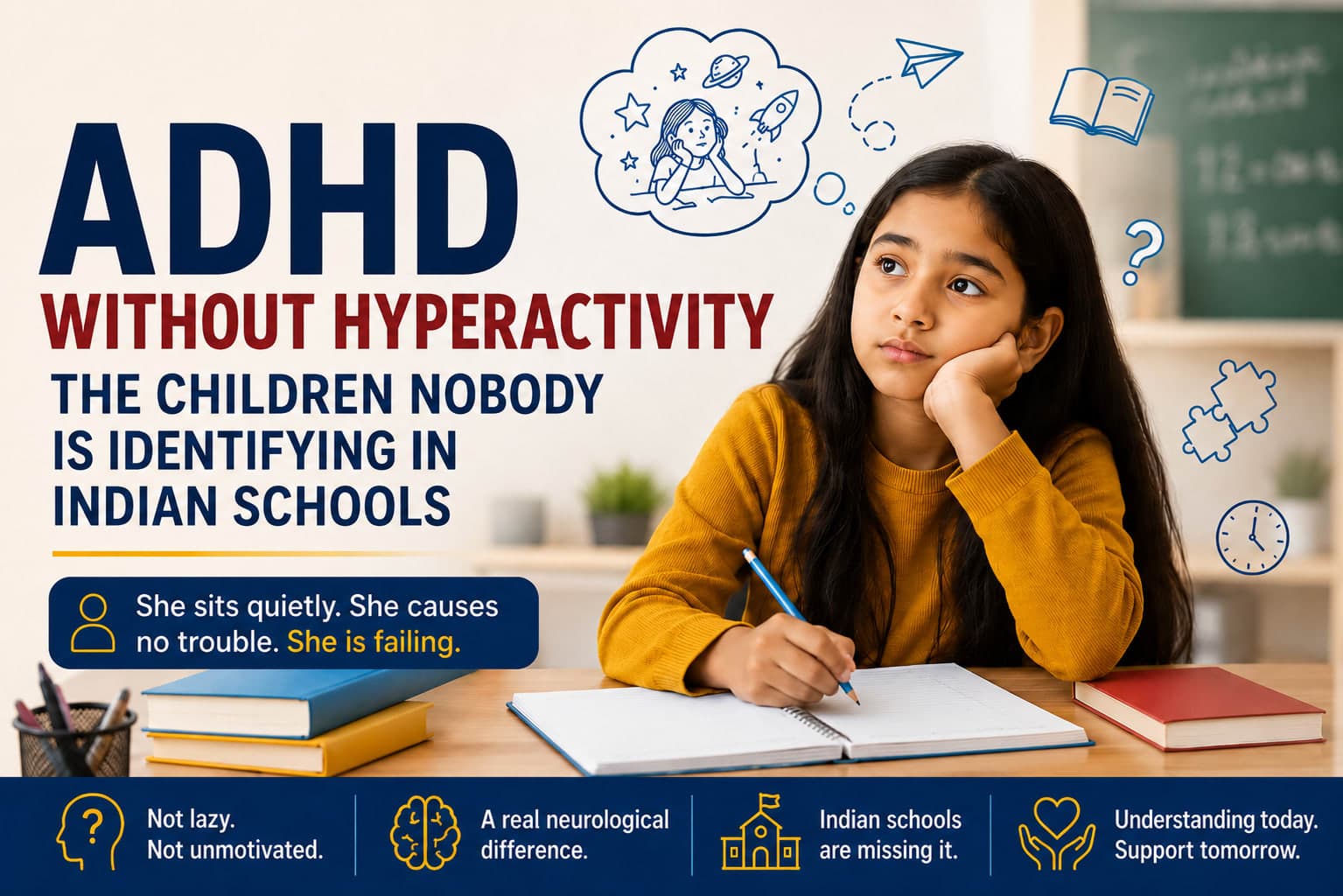
She Sits Quietly. She Causes No Trouble. She Is Failing.
Ananya was nine when her mother first brought her concerns to me. Ananya was, by every teacher's account, a lovely child. Polite. Well-behaved. Never disruptive. She also hadn't completed a classwork assignment in three months. Her test scores had dropped from average to failing over the course of a year. She lost her pencil case so regularly that her mother had stopped buying good ones. And when her mother asked her what she had done at school that day, Ananya would look slightly confused — as if the question required her to remember something from very far away.
'She's just not applying herself,' her class teacher said. 'She's a bright girl. She needs to focus.'
Her mother had heard variations of this for two years. Ananya had ADHD — specifically the inattentive presentation. The type that looks nothing like what most people picture when they hear the word.
Section 01
The Three Presentations of ADHD
ADHD Predominantly Hyperactive-Impulsive:
The presentation most people recognise. The child who cannot sit still, who blurts out answers, who runs when they should walk. This child is hard to miss.
ADHD Predominantly Inattentive:
The child who appears to be paying attention but is not. Who loses things constantly. Who forgets instructions moments after hearing them. Who daydreams. This child is easy to miss — because from the outside, they look like they are just sitting there.
ADHD Combined Presentation:
Both inattentive and hyperactive-impulsive features are present. This is the most common clinical presentation.
Section 02
Why Indian Schools Are Specifically Designed to Miss This
Large class sizes — a teacher's attention is drawn to disruption, not quiet underperformance
Rote learning and passive instruction — inattention is invisible when no active participation is required
Behaviour as the primary referral criterion — the inattentive child is not causing problems
The 'bright but lazy' narrative — underperformance attributed to effort, not neurology
Tuition culture — adding more of the same instruction that is not working
Section 03
What Inattentive ADHD Actually Looks Like
In the Classroom
The inattentive child is sitting at her desk. But she is somewhere else entirely. She hears the teacher give an instruction. By the time she has processed the first part, the teacher has moved on. She starts her classwork with good intentions. Three lines in, a thought arrives — something completely unrelated — and she follows it. When she surfaces, ten minutes have passed and she is lost.
At Home
Homework is a battle nobody is winning. She sits down, gets distracted, and surfaces forty-five minutes later having written two sentences. She forgets to tell her parents about the school trip until the night before. She loses her water bottle, her library book, her permission slips — consistently, not occasionally.
The Emotional Layer
By the time a child with inattentive ADHD reaches me, they have almost always spent years being told — directly or indirectly — that their failures are their own fault. They believe they are lazy. They believe they are stupid. They have a relationship with academic work defined by shame, avoidance, and a deep-seated expectation of failure.
Section 04
Why Girls Are Disproportionately Missed
The hyperactive stereotype is male — a girl sitting quietly does not match the ADHD template
Girls mask more effectively — copying peers, using social skills to paper over academic gaps
Inattentive symptoms are more socially tolerated in girls — 'she's sensitive' or 'she's creative'
Anxiety and depression present first — ADHD remains unaddressed for years
Section 05
What Assessment and Support Look Like
Assessment includes:
Detailed developmental and academic history
Standardised rating scales completed by parents AND teachers — both are required
Cognitive assessment — to identify the gap between potential and performance
Attention and executive function testing
Screening for co-occurring conditions — anxiety, learning disabilities, low self-esteem
Support includes:
School accommodations under RPWD Act 2016
Executive function coaching
Parent coaching
Therapy for co-occurring emotional difficulties
Medication where appropriate — covered in Blog #11
*If your child is the quiet one — the one who is not causing trouble but is clearly not thriving — reach out through thechildpsychologist.in or call 7999215093.*
Section 06
If You Are in Indore or Nearby
If you are based in Indore, Bhopal, Ujjain, Dewas, or nearby areas, Dr. Vini Jhariya is available for in-person consultations. For families outside Indore — across India and internationally — online consultations are available through thechildpsychologist.in.
Address: 100-A Baikunth Dham Colony, Old Palasia, Saket, Indore, Madhya Pradesh
Phone: 7999215093
Website: thechildpsychologist.in
Section 07
She Needed Someone to Look More Carefully
Ananya's assessment confirmed inattentive ADHD with significant anxiety. Six months later, her mother sent a photograph of Ananya's latest test paper. Seventy-two percent. At the bottom, in the margin, Ananya had written in pencil: 'I am not stupid.' She never was. She just needed someone to look more carefully. Reach out through thechildpsychologist.in or call 7999215093.
A note for parents
This article is educational guidance and does not replace an individual psychological consultation or assessment.
Questions and answers