
"The Report Says Level 2. What Does That Mean?"
Rohit's parents sat across from me three days after receiving their son's diagnostic report. They had Googled "autism Level 2" and found a mix of clinical definitions, American parenting forums, and one article using the phrase "moderately severe autism" — a phrase that had kept Rohit's mother awake for two nights.
"Does it mean he will never talk?"
None of those things, as it turned out. But nobody had taken twenty minutes to explain that to them.
Where Autism Levels Come From
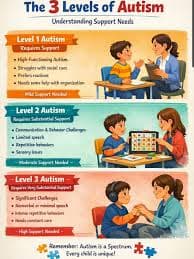
Autism levels — Level 1, 2, and 3 — come from the DSM-5, introduced in 2013, which unified the older separate diagnoses such as Autistic Disorder, Asperger Syndrome, and PDD-NOS under Autism Spectrum Disorder.
The three levels reflect the degree of support a person currently needs in social communication and in restricted, repetitive behaviours.
The word "currently" is critical.
Autism Level 1 — What It Actually Looks Like
Clinical definition: "Requires support."
In daily life:
A child with Level 1 autism typically speaks — sometimes remarkably well. What they struggle with is the invisible grammar of social interaction — the unspoken rules, reading facial expressions, knowing when to stop talking about their special interest.
At school they may manage academically but find unstructured time — lunch breaks, free periods — the hardest part of the day.
Therapy priorities for Level 1
Social communication therapy — learning social rules that others absorb intuitively
CBT — particularly for the anxiety that frequently co-occurs with Level 1 autism
School accommodations for unstructured time, group work, and transitions
Autism Level 2 — What It Actually Looks Like
Clinical definition: "Requires substantial support."
In daily life:
A child with Level 2 autism typically has delayed speech or speech that is functional but limited. Transitions are genuinely difficult.
In Indian joint families, Level 2 autism creates specific stresses — a child who cannot tolerate noise at a family gathering is frequently interpreted as bad parenting rather than neurological difference.
Therapy priorities for Level 2
Intensive, coordinated intervention — speech therapy, OT, and ABA delivered consistently
Therapy-integrated schooling
Intensive parent training
Autism Level 3 — What It Actually Looks Like
Clinical definition: "Requires very substantial support."
In daily life:
A child with Level 3 autism often has very limited functional speech or may be non-speaking.
Non-speaking autistic individuals are not cognitively absent. The absence of speech is a communication barrier, not an intelligence ceiling.
Behaviours that challenge are almost always communication — the child is telling you something they cannot yet say in words.
Therapy priorities for Level 3
AAC — Augmentative and Alternative Communication, such as picture systems and communication apps
High-intensity, consistent intervention across all areas
A specialist educational setting
Significant parent training and caregiver support
The Most Important Thing Nobody Tells Parents About Autism Levels
Autism levels are not fixed.
They describe current support needs — and current support needs can change.
I have seen children diagnosed at Level 3 at age three who, after several years of consistent high-quality early intervention, function at a Level 1 profile by age eight.
The level tells you where your child is today. It does not tell you where they will be in three years with the right support.
If you have received a diagnosis and are trying to understand what level of intervention your child needs, reach out through thechildpsychologist.in or call 7999215093.
Section 01
If You Are in Indore or Nearby
If you are based in Indore, Bhopal, Ujjain, Dewas, or nearby areas, Dr. Vini Jhariya is available for in-person consultations.
For families outside Indore — across India and internationally — online consultations are available through thechildpsychologist.in.
Address: 100-A Baikunth Dham Colony, Old Palasia, Saket, Indore, Madhya Pradesh
Phone: 7999215093
Website: thechildpsychologist.in
A note for parents
This article is educational guidance and does not replace an individual psychological consultation or assessment.
Questions and answers